Notes, 1987, Lima
Reference Texts:
Introduction to Dialectics, F. Engels.
The Origin of the Family, Private Property, and the State, F. Engels.
The Part Played by Labor in the Transition from Ape to Man, F. Engels.
Karl Marx Selected Works, Volume II. Lenin.
Many have argued that what makes up the mind of man is mathematics. One can no longer think like that. Others propose logic. Neither mathematics nor logic are systems that make up the mind of man. It is philosophy, the process of knowledge through different stages and modes of production.
Dealing with the laws governing the development of man, Lenin went so far as to establish that philosophy was an eminently political necessity. “The core of ideology is philosophy.” Lenin set about studying the whole process of philosophy from the Marxist point of view. He studied Hegel’s science of logic.
Philosophical Notebooks, Lenin.
Volume IV On Practice and On Contradiction. Chairman Mao.
Without philosophy there is no party.
Reject the criterion that philosophy is only going to be given from the Greek world. Later studies show that this is a prejudice, contempt for the thought of other peoples. Process in China, India. As civilization advances, peoples strive to know the foundation of things, the why of things. Egypt, Mesopotamia, the Hebrew people: places where there is a process of development, still considered as a pre-philosophy; the process of development is denied from the earliest times. With their own religions: the Egyptians argue that the waters are the primordial principle, a symbol of life, but they do not know where the Nile comes from; when it expands the Nile leaves some islands and in them the spirit develops. They pose two questions: Spirit and Matter. What’s important is that they always posed a principle that is matter.
The Greeks are the ones who posed a more developed philosophy, linked to the process of the market, the appearance of currency and linked to science. Thales predicts the first eclipse. The Egyptians knew mathematical questions by practice; it is the Greeks who explained and demonstrated the facts. Advancement in scientific knowledge and the class struggle of slaveholders, sharpening of the struggle between merchants and farmers, “Greek democracy” that has a dictatorial process before democracy. It is intended to make us see (that) philosophy is developed outside of classes, 7th and 6th centuries BC.
Arche: origin, the reason of things is the origin: the beginning of things is the waters, it is the law from which everything derives. Original chaos and the order in things. The Egyptians already said this. He made inquiries and found shells (fossils) on the islands. Another thinker said that the origin is air, always a material origin.
He states that the origin of things is fire: material reality is therefore materialistic. War is the origin of all things, the struggle of two opposites and from this struggle we have a process of constant development, everything is a permanent flow, no one bathes twice in the same waters. Here we have the dialectic. Genius intuitions. Of them we have been left with only phrases, nothing more. Aristotle’s history is all. Genius intuitions, but not fundamentals. The contradiction of philosophy is against religion. It breaks away from religion. Idealism appears. Parmenides denies the dialectic and arises as a counter-position to Heraclitus: he has two heads, one affirms and another denies, does not reason. He states that the origin of all things is being: it is absolute being, encompassing everything; things exist because they participate in being.
| Metaphysics: | BEING |
Being has no movement; if it were to move, it would be non-being. Men at that time could not refute this.
Materialism starts from prior matter and from a process of knowledge.
The first are the materialists, the idealists come later.
Great materialist. Theory of atoms: that which cannot be split. A minimum material instance. All that exists are small particles that cannot be broken, eternal and in continuous movement. Thus he refutes the idealist theories of Parmenides of the infinite divisibility that would lead to non-existence. It is not until 1900 that the indivisibility of the atom is refuted.
Knowledge is a reflection of atoms in the head. The effluvia intertwine and this is reflected in our head, from which we have error. He proposes that man develops socially. The integral part of the Polis. This reflects what he sees in his own city. Slavery is harmful because it lowers man, because it debases the human being, does not allow him to give the best of himself; freedom corresponds to it. Man must be free, to enter the field of morality, to know what would allow him to live freely. [Democritus is] the greatest exponent of materialism in ancient times.
Materialism has always developed with an understanding and respect for man. Its thought was harmful to society and the criteria of the ruling class; all idealistic criteria are linked to the merchants and the slaveholders. The sophists argue that man can be educated and thus elevate himself. Man is the measure of all things. In Socrates we see how the Greeks were extremely social; individualism was not developed.
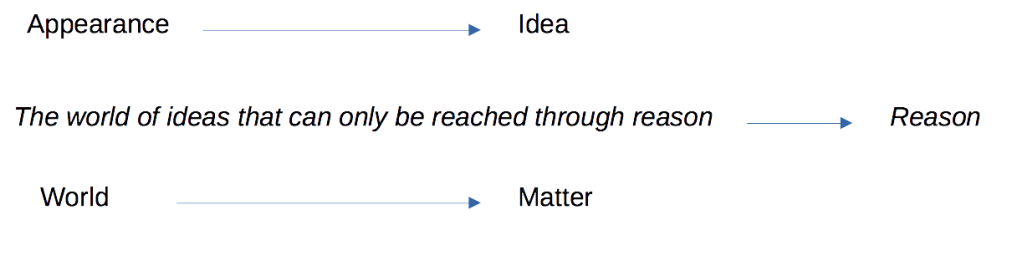
Linked to the aristocracy, very wealthy, systematizes all idealist thought. He maintains that there is an appearance and a reality, that the senses are deceptive, that the appearance is idea and the world is matter:
The reality of things participate in the ideas. He raises a trinity of ideas: good, beauty, and truth and these three are sustained by being. Theory of the joint participation of ideas. He raises the Platonic communism that has a precedent in Egypt: a reactionary communism. He understands that property generates struggles. For him the democratic order was harmful; he thought of a government of elites. For him education was harmful. He understood it because the aristocracy was being attacked, destroyed by the merchants. Society: a set of workers who are classified according to how they are educated: workers, warriors, etc. And there remains a group of elites (fascism). [He rejects teaching] music because it corrupts. He destroyed every part of Democritus that came within his reach.
Disciple of Plato. He informs us of everything the materialists thought, criticizes Plato and relies heavily on the scientific and social knowledge of the time. Aristotle based himself on scientific knowledge and criticizes Plato:
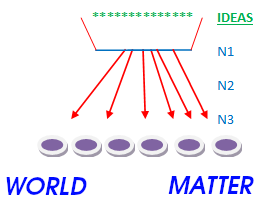
Things exist but they have a material reality and a form; if they did not have form then they would be confused. Things exist because they have a materiality and a form. Aristotle arrives at idealism from a real base; he puts the idea into reality. He begins to handle the concepts and forms, essence: a substance and an essence. There is a primary reality, a superior essence that imprints movement, because there is a prime motor mover, god, the word that knows itself. He arrives at idealism craftily. Things really exist, this cannot be denied but Aristotle comes to the thought that thinks itself, and this thinking of itself is what sets reality in motion.
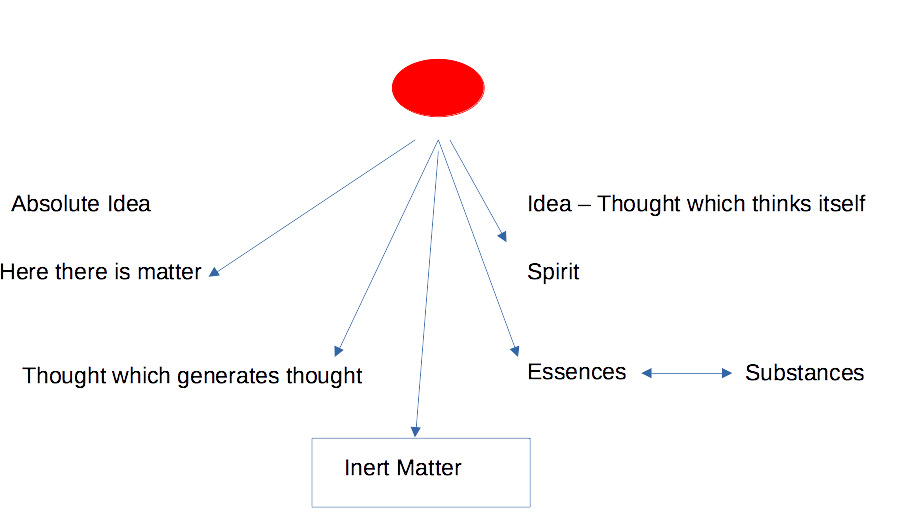
As a concrete reality, matter has no movement; it is the idea that moves, first mover (prime engine). Conceptual dialectic. The positive thing about it is that matter exists. It is another form of Platonism.
The Romans could never overcome this: Neo-platonism as decadence that amounts to mysticism (Plotinus). The church cannot affiliate with Platonism.
Philosophy begins to develop as a vindication of reason. On account of the Arabs, it is through them that Greek philosophy began to be known and one began to know Aristotelianism. The Arabs develop a materialist criterion and differentiate philosophy from theology. Philosophy deals with the earth and theology with heaven. The Arabs and the Hebrews are the ones who have influence.
The realists apply the Aristotelian theses: the reality of things and ideas also exist independently.
Nominalists are nothing but empty mouths, without real content, they are derivations extracted from things. Religious ideas are confronted.
Begins to handle formal logic, creator of deductive logic. He handles logic in a dialectical way (debate, discussion). He is very important for French thought. He attacks religion. Marx considers nominalism to be of great importance.
Very important, he was a Franciscan. The root of modern materialism is in this personage: how to combat religion? Communion.

How many times and how many men receive communion? There would no body of Christ left. All those who opposed were dead, a very violent, very hard time. They love to present the philosophers as desk-men; the reality has not been like that. Poison and the knife has been the way of debate in philosophy.
Thomism, (Augustinianism–neo-platonism), an Italian who joins the Dominican Order. Disciple of Albert the Great: he argues that one can rationally understand the Catholic religion. Reason is not opposed to theology. This is based on deforming Aristotle; it is not a development of Aristotle, it is much lower. His most important work is Being and Reason (Bertrand Russell). In his lifetime he was persecuted by the church and that is fundamental. (Ockham together with Scotto refuted Thomism).
The philosophical process begins to unfold with the bourgeoisie (Francis Bacon) defending experience (the Novum Organum). He develops an inductive logic that will serve science. He states that his thought encompasses the thought of men (he recognizes the theology, but as separate).
Was a disciple of the Jesuits. He understood that what in one people is affirmed, in another is denied; that science did not have solid foundations (Cartesian coordinates that allow taking geometry to algebraic analysis). He was a student of the physics of the world, of matter; he takes up the thought of Democritus. He is a materialist in that field. He raises methodical doubt (it is not the type of skepticism that questions knowledge, that does not trust knowledge) you have to doubt in order to arrive at an evident knowledge. He raises the deception of sight. The senses deceive, you cannot believe the senses, but there is something that is evident. I cannot doubt that I exist: here is an incontrovertible truth. I doubt, therefore I exist. Whatever it may present to reality, there is something undeniable. I think, therefore I am. Evident truth before whose existence there is no doubt. I exist and my thoughts exist. You see reality through your thoughts.
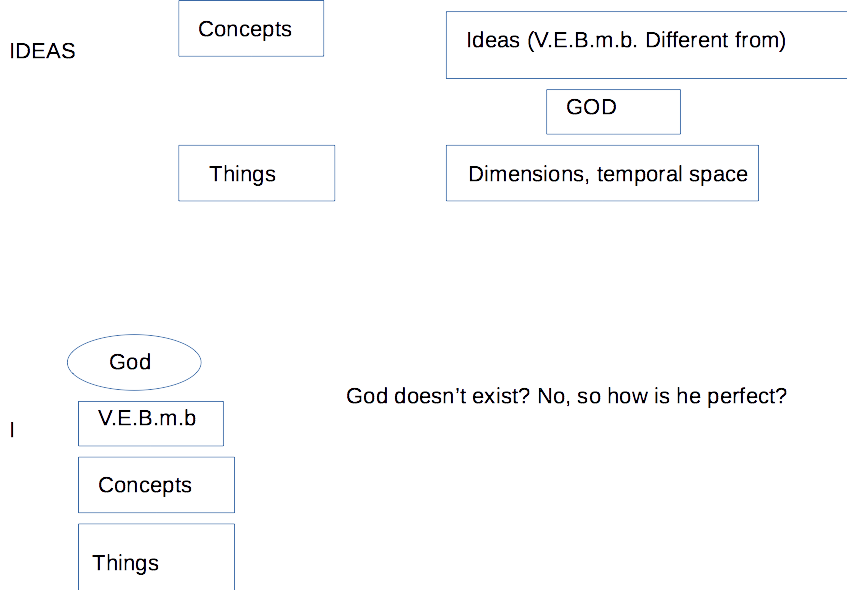
I have ideas, it is because God exists and he has given everything. Everything exists because God exists. When Descartes develops science he is materialistic, but when he develops metaphysical ideas, he turns towards the philosophy the “I,” from here onward the foundation of bourgeois thought begins.
The materialist school is contrary in taking up Democritus.
German Philosophy: Leibniz, Kant, and Hegel.
17th-19th century (1830). 150 years or so.
Lutheranism: Clean out the church stables.
Germany gives the most advanced thought of the idealist school. Leibniz: great mathematician. Develops logic, rethinks Aristotle’s logic. He did not spread his thoughts. He develops a rationalism. A logical analysis is possible. Logic with symbols to handle it as in mathematical analysis. Set of axioms that, following a calculation, can solve all absolute truths. Theory of monads: closed entities. They communicated through a small window, ideals, self-movement. Problem of dynamics, but this is conceptual because it is idealist. He dedicates himself to analyzing human knowledge, linking mathematics and physics.
He focuses on the problem of knowledge. Critique of pure reason. He proposes that reality exists but as a phenomenon, as that which appears: that which light shows. He establishes a difference between phenomena. There is a part of the thing that appears and another, the thing in itself, that does not appear. Matter exists but is not known. He establishes a relationship between the knowing subject and the known object, but there is a part that is not known. Analyzing the things, we have sensations that I grasp through my sensibility.
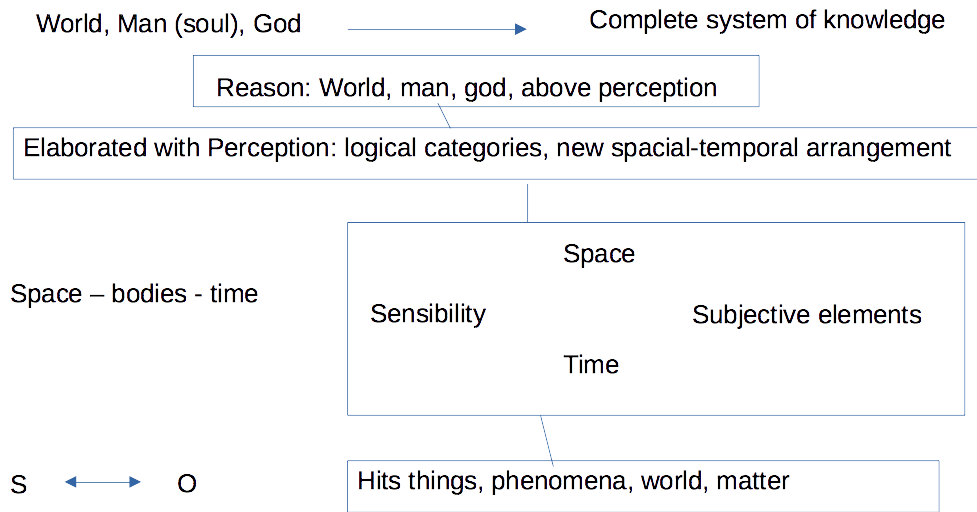
Elaborate concepts
Categories: logical system of knowledge. I only know the phenomena, the thing itself escapes my knowledge, knowledge becomes an elaboration of pure reason (PR), an elaboration between the subject and the object (things), but the subject is the most important thing. There is a reality that I can know and another that I cannot know. The thing allows itself to be known.
After Kant, neo-Kantism develops, which dissolves the thing in itself; the thing in itself is an elaboration of the thing in itself. It goes from idealism to ultra-idealism. Kant has come to know by understanding. Critique of Practical Reason: when he analyzes the soul he comes to think of freedom and this can only be attained in God. Freedom, the soul and the lap of god. He orders the understanding of knowledge and expresses the limits of idealism (reason). Why is it said that God exists? In order to explain that everything has a beginning and an end one looks for the cause and this cause is God, but when stating that God is the cause, what is the cause of God? The same argument refutes the existence of god.
He asks himself what is laid out above. What Kant intends is to know reality from his “I”; he does not focus on the objective. The problem is to start from the objective. Hegel analyzes the process of philosophy, he thought that all philosophers were before him. All other peoples did not exist for him, they were nothing. He develops a theory of dialectics that allowed the understanding of the entire process of matter (his problem is that it was idealist). The process unfolds by contradiction and is it unfolds it generates the problem of quantity and quality, appearance and reality. He understood the dialectic as a process of contradiction between concepts, ideas. He will deny the application of his own dialectic. He states that there is an absolute idea. The absolute idea is objective reality whose process is contradiction at the level of ideas only. This is similar to Aristotle but without starting from matter. This idea is judged by the very process of contradiction to matter. Being the spirit itself, it begins to unfold until it generates man and the spirit becomes self-consciousness, the spirit negates itself. Man: society, knowledge, science, art, religion, nation and then generates the state. The state transforms itself, a great transformation that finally becomes Spirit, god. Absolute Idea:
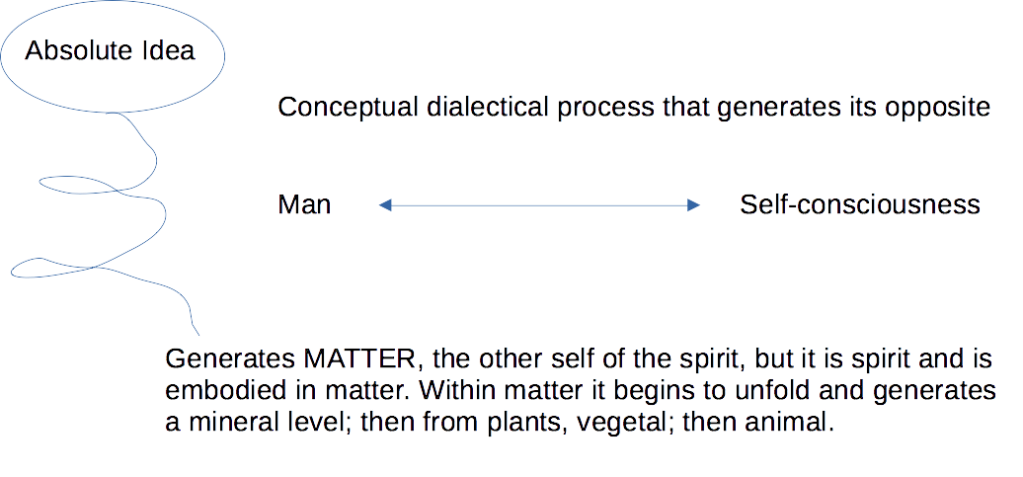
This has an understanding of a while development of materialism but it is idealistic. Two parts, its idealism—disposable—and its materialism that is acceptable.
Materialistic process in France: Diderot. Eternal matter, it has no beginning and no end, He goes so far as to pose that there is an internal self-movement that drives matter, but does not explain why. But the antecedent of Marxist philosophy is classical German philosophy. After Hegel’s death there a division, some begin to criticize Hegel’s idealism; the one that interests us is Feuerbach. He criticizes Hegel’s idealism but does not differentiate Hegel’s materialism from Hegel’s idealism. This leads him to discard Hegel. The phenomenon of alienation in the face of religion (alienation, enajenación, is Hegel’s word) is not a thesis of Marx, this differentiates the young Marx from the acrimonious Marx [amargo]. Marx rejects it because the solution is revolution, emancipation.
Hegel: work removes man from his essence as a thinking being, a national being.
Marx analyzes the causes of alienation.
Feuerbach argues that before alienation the center is man, not God. The relationship is love, charity, to see for the other, motherhood: it is a subjectivist position of how one self relates to another self. Christianity without Christ. The important thing is the materialist critique.
Marx and Engels lead a struggle against Feuerbach’s individualism.
Marx and Engels are going to develop the Marxist philosophical process. Marx developed and Engels disseminated. The Theses on Feuerbach form the basis:
1st: defect of all previous materialism: failing to take practice into account. The earlier materialism had developed into empiricism or seeing reality as something passive, not understanding how matter acts and how man through his work change reality (grasping reality). All empiricism is a bourgeois position. Postulate: understand reality and transform it.
2nd: Practice and truth, practice as proof of truth. Marx criticizes Feuerbach, he never conceived sensory perception in its a transformative capacity. He had diluted the religious essence in the human essence, a Christianity without Christ, the inability to understand the social world, social relationships.
3rd: social life is essentially practical. The human mind is misled by a set of mysticisms. Only by understanding practice can you sweep away mysticism. Since they do not understand practice he calls it contemplative materialism. Civil society: the most it had advanced was the study of institutions, which is the root that sustains it. Transforming the world: philosophers have done nothing more than contemplate the world but the problem is to transform it.
With this document he demarcates the camps.
Reckoning with his previous thoughts in a new position. New criteria are posed to form the new ideology. Thus is posed the economic process of society. Communism is posed as the first great revolution in the world, since all earlier revolutions were the substitution of one class for another.
All philosophy in its long journey had developed a theory of dialectics and of materialism. They rightly criticize the Middle Ages. A dispute that wanted to resolve questions without seeing reality. They could see the developmental milestones well. They affirm their resounding materialist position. To access materialism demands a process of movement derived from contradiction.
Althusser denies that Marx and Engels took up Hegel’s dialectic. He argues that first science develops and then the leap occurs. The discovery of Marx and Engels is the historical materialism because they founded the materialist theory of history and then dialectical materialism. According to Althusser, the development of Marxist philosophy was pending. It is stupidity from start to finish.
Plato and Kant are idealists. Althusser denies the scientific process that has been developing since the 17th century. Since the end of the 16th century it was thought that the earth was something that changes, a form of movement. Dialectical process. Chemistry: there is no Chinese wall between organic and inorganic chemistry. Biology: the cell is discovered, in animals transitional forms are seen: as links. Theory of evolution. Thus science breaks with metaphysics as processes, developments. Althusser cannot deny this. Thus science demanded a dialectical explanation. Hegel had put the dialectical process on its head. What Marx does is put it into the material. This was never done before. Dialectical materialism is able to enter into knowledge and transformation by man acting on matter. The scientific character of Marxism is questioned; matter is transformed through practice.
The ideology that the exploiting classes have generated is inverted because it gives an idealistic explanation of history. Our ideology is scientific because it is a true reflection verified by its practice and its class character. Althusser’s theories lead to a new surrealism, making possible the merger of the theories of Kant and Spinoza. It takes a bourgeois rationalism and a bourgeois idealism. This process has a trajectory of 2500 years; it has a solid historical foundation in which the best has been gathered, resulting in Marxism-Leninism-Maoism. The application of dialectical materialism gives rise to historical materialism and the scientific understanding of society.
There has been a process to demonstrate the economic foundations of society. “What Marxism does is economically criticize society” say those who attack it. Ideology is generated from the economic base and from society. The problem of ideas and the action that sustains them has not been left behind.
Dialectics: Engels is the one who deals with this question: three laws. Unity and struggle of contradiction, the leap, and the negation of the negation. They understood that the 1st is principal. If they had not understood the dialectic they would not have been able to develop Capital. It is not a circle; Marxism is a dialectical process that will continue to develop. This demarcates us from all the philosophical processes that are closed.
Hegel is inconsistently dialectical and we are consistently dialectical. This is the greatest revolution there was in the history of mankind. Marxist philosophy lays the foundations of development. Knowledge can never be exhausted; it is a process that gets closer and closer to the truth and discards new errors. Denials of Marxism: this phenomenon has been constant. In Materialism and Empirio-criticism, Lenin upholds and defends Marxism and develops it. Theory of reflection. Set of reflections that generate consciousness. Reflection is a characteristic that is a characteristic of matter, action, and reaction. Consciousness becomes a long process of the characteristic of matter. The atoms. In 1900 a German physicist stated that there is a very small amount of matter necessary to make a leap, quantum theory, with this nuclear theory opens. What Einstein made is a new theory of space-time.
There are two absolutes as inseparable entities, what he suggests is that space and time are relative. Experiments showed that at high speeds there was a reduction. The problem is that time and space vary according to velocity, two absolutes become two relatives. Gravity of matter that moves in wider ways. Quantum physics breaking the atom, negating matter, Lenin says that we are beginning to know the primary particles. Matter in motion has a quantitative and qualitative form, we are seeing new forms of matter because matter is eternal movement. Lenin rejects that matter is dissolved.
Partisan character of philosophy and the fight against Empirio-criticism. Quantum physics is going to make room for the denial of materialism. If we know the velocity of the electron, we do not know its location, so causality is denied: this has two meanings, it expressed the correlation between a cause and an effect, and the other is the problem of predictability. Cause-effect has been confused with predictability, but cause-effect still exists. Basing on predictability they deny the cause and effect. So what we have found is chance [casualidad] and what has been discovered is another form of matter. New modalities of matter, new forms.
Two parallel lines meet from the inner side add up to less than two straight lines. 5th Postulate. Presuppositions. Geometry of parallel lines. (Triangle) 180º, for many centuries this was considered to be the only geometry.
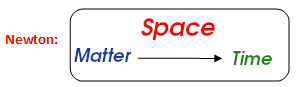
Gauss stated that it has no proof, whoever changes this postulate generates another geometry. When the conic comes they find that it is inadequate. Reimann’s geometry. 180º Lobachevsky-Bolyai geometry. (drawing).
Before we talked about a flat space, another curved and another concave. Thus matter has many manifestations. Convex, flat, concave? (future development).
Instead of questioning what they do is confirm. Matter is inexhaustible. How many processes will develop. Eternity of matter in eternal motion (understood as the most basic possible problem). Nowadays matter is conceived as an interruption of nothingness. And what is nothingness? Separate space from matter. Jordan. Nothingness is a space, and space is a modality of matter.
It is discovered that there are stars that move at great speeds: the so-called expansion of the universe, they reach the concentration-point of the universe. This, they say, shows that there has been a beginning and therefore it is not eternal and, second, that it has a limit. They say that before there was no universe, the initial moment of creation. This comes from fact that the environment we know it is 15,000,000,000 years old. Others go so far as to say that it is 6,000 million years old; the facts show that the part of the universe we know started at that time more or less. What is being done is generalizing what little we know. What is affirmed for a part cannot be affirmed for the whole. It is intended (Russell) to introduce divinity through the back door.
Movement has a quantitative and a qualitative aspect.
Bourgeois philosophy enters a process of clear decline. Lukács argues that the contradiction is not materialism-idealism, but irrationalism-rationalism. This poses an acute crisis of bourgeois philosophy.
Bergson: develops a metaphysics full of lachrymosity.
Nietzsche: superman theory, an extraordinary pen. Theories that seek a way out of imperialism. Moral theory based on the betters and their dominance. Privileged men and sheepish minds; it aims against Christianity, trying to reestablish the morality of the lords. Christianity confuses goodness with virtue. Christians are the most powerful, the strongest. This is pure racism.
In the 1920s it tries to re-launch. Neopositivists: emerging in Vienna circles: positivism, reactionary response of the bourgeois captains. It raises the need to believe in positive science, denies the existence of laws in reality and proposes that reality are things that we elaborate, knowledge. The new science is a religiosity, the best world is the bourgeois world and the problem is order and progress.
Neopositivists: start from phenomena, leads to scientism. It is the subject that elaborates a system of science, law, falls into a development of logic.
Develops systems derived from science, mathematics.
He proposed that the essence of things was the number, that everything could be measured, Plato develops it. All knowledge is reduced to formulas. The downside is replacing reality with formulas; the fact is that mathematics comes out of material reality. The circle came out the wheel; it considers math a substitute for reality. (To make a hole in the wall with an integral and not with what the integral represents—a drill). Logic: they begin to analyze, they argue that language is insufficient and that it is necessary to replace it with symbols, to arrive at something you have to simplify everything. It is positive in the sense that it gives us a development of logic, symbolic logic. They speak of criteria of verification, proof of truth. It ends up not analyzing matter, but rather analyzing the analysis of matter (logical analysis).
The most consistent of the neo-positivists. “I can’t talk about the world, you can ask me how I interpret the world, the world is not knowable, what I can speak about is the knowledge that I have of the world, I cannot speak of the others systems because I don’t know them, the best thing to do is shut up, you can’t say anything about anything. One reaches the ineffable. Be quiet. Divinity, the limit of contemplation.” God in sight. Scientists and analysis of science, logicism. Absolute denial of knowledge. Russell, Bertrand. Comrades in ancient times, Nunme and Rosses, their analyses lead to the undoing of knowledge.
They all arrive at agnosticism. Principia Mathematica. Creators of modern logic. Platonic mathematicism, logicist, platonic plain-mysticism “Everything I have said up to now is invalid and I don’t know if what I am saying now will be valid.”
Analysis, they stay in disassembly and do not get to the assembling; they do not make any synthesis. However, they discover paradoxes that allow us to advance, when we think we are thinking in finite terms and they have been cleaning up philosophy and science. Knowledge has entered a critical moment, there is a moment of synthesis, and once again it begins to expand. Demolition of the concepts of science, everything has entered into crisis. The proletariat will establish these new principles. The process of demolition is not over. There is a class that is dying and its principles die with it. Confusion is the result.
Heidegger. 1920. Analysis of existence, the creator God. Philosophy must focus on the existence of things. Man is the expression of existence, he comes from nothingness and goes to nothingness. He knows nothing of his existence, where he comes from. In his travels is anguish, when this happens there are two attitudes: to face or to flee from that anguish. The problem is facing his anguish, facing his death, being for death, that is the identity of man, to live for death. It served Nazism, it is an expression of a class that is dying. Expression of philosophical decadence.
He is from the same school. Man is a being without existence that seeks existence and seeks to cling to something to express his existence, man reduces everything to nothing, seeks to cling to things, but that’s a false start, in another human being, each one becomes nothing (Auhilar). Another way out is love, but it is the same situation, then there is God, but God does not exist. Then there remains your own freedom, this is the solution. You only have the alternative of living or dying. Pessimism, no way out, freedom is a relationship that occurs in society.
Man comes from God and goes to God, the problem then is to reach God. All these are expressions of the class that has no way out.
Maritain. The church remains in Thomism. Catholic thinkers have thought to adjust Thomism taking into account the development of science in philosophy. The fact of wanting to take a feudal conception shows the ideological poverty of the church. It is born dead because it is a philosophy that is already dead. Husserl’s successors: Deconte’s application. Phenomenology. Tries to overcome Deconte’s mistakes. Garcia Baca. García Morente, from the school of Neo-Thomism. Chairman Mao used to say that one cannot be vaccinated against idealism if one does not know it.
The main law: Plekhanov argued that Marxism poses monism. Materialism is the base, the guideline is the dialectic and in this the main thing is the contradiction. Marx-Engels do not get to raise what is the core. With C. Stalin there is a regression. Chairman Mao argues that the only law is contradiction and the others are derivations. With Chairman Mao we arrive at philosophical monism; the only law. This does not imply that the system has been completed. Questions concerning freedom, on the one hand it is consciousness of necessity and the other aspect is transformation of necessity and this is principle. Dialectic: the most general laws of the development of the natural world, of the social world and of knowledge, understood as the reflection of material reality in the mind of man. The difficulty would be in the laws. It is Chairman Mao who proposes a single law, considering the law of contradiction as the only law.
Plekhanov: he proposes monism, though he starts from the laws and classes, he also takes into account the individual as the individual can disrupt it. Assume the law and carry it forward, from the purest form and fulfill the role that the revolution demands. There are peculiarities but the main thing is to take up the law and carry it forward. Marxism-Leninism-Maoism combats individualism and its root egoism, fighting the “me first.” The individual develops historically, private property strengthened individuality and selfishness, the bourgeoisie strengthens individualism to the maximum, to the point of excess. Marxism, centering on the class, rejects individualism, selfishness, in the P. is where it imprints a new way of being, shaping us. Action in the class struggle is what is principle; working collectively dilutes the education we bring with us.
By making the revolution, the world is transformed and so are men. The root is selfishness and it is a basis for revisionism and it takes time. Uprooting individualism will be a long process. As new and more developed production relationships are generated, it will be more and more reflected in the ideas throughout society.
Communists must be trumpets that announce the future. Ideology allows us to develop and advance in the struggle against selfishness. We must be the most advanced. We work for a goal that we will not see. Increasingly reduce individualism and selfishness. It is in struggle where action hits individualism the hardest. Ideology is what allows us to advance.